
There is a big demand for law enforcement transcriptionists.
Law enforcement agencies, police departments, public defenders, prosecutors, attorneys, and security companies need transcription of audio and video that is related to criminal investigations and evidence. The transcription of audio and video provides documentation and clarity.
Law enforcement has a large number of caseloads and doesn't have enough qualified staff to do transcription in-house.
New recording technology has increased the need for law enforcement transcription.
Today, police officers and law enforcement professionals can dictate and record traffic accidents and violations with digital recording devices. This has also increased the amount of transcription needed.
Outsourcing digital video and audio is easier, faster, and safer.
Many law enforcement agencies are outsourcing transcription to transcription companies and freelance transcriptionists. Here's why:
- Outsourcing reduces overhead and cost. Outsourcing transcription costs less than keeping transcription in-house. It eliminates the need to hire additional staff or pay overtime to current staff, purchase extra software and hardware, and train employees to do transcription work.
- Better use of staff.
- Doing transcription work in-house requires time and resources. It is time-consuming for people who are not experienced in transcription.
- Outsourcing transcription reduces workload and allows officers and staff to focus on their main responsibilities, important casework, and tasks that better utilize their expertise.
- Faster turnaround. Outsourcing transcription provides a faster turnaround time and helps to complete the transcripts on time.
- Improved accuracy. A professional transcriptionist can provide more accurate transcripts than an in-house staff that is not experienced in transcription.
- Safe file transfer and tracking. Secure file transfer systems conveniently and instantly transfer digital files, encrypt files, protect confidentiality, and keep track of where the files are. Transmitting digital audio and video files via the Internet eliminates loss and damage to the recordings. The use of secure servers reduces security and confidentiality concerns.
Skills and Training
Training in legal transcription is available from vocational schools, community colleges, and online courses. Programs typically cover legal terminology, research, and the formats used for pleadings, testimony, and other documentation. Training programs typically range from three to six months.
Online courses enable you to study at your own pace. If you're a paralegal, legal secretary, or legal assistant, your learning curve will be shorter because you are already familiar with legal terminology, documents, and conventions.
- You do not have to be a court reporter to become a law enforcement transcriptionist and transcribe investigative interviews and interrogations.
- You do not need to be a medical transcriptionist either.
- Legal transcriptionists are best suited to do law enforcement transcription.
Janet Shaughnessy’s Legal Transcription Course includes a full chapter about law enforcement transcription. This is a great, multi-media course I highly recommend for people wanting to get into legal transcription. Click here to get more information about her Legal Transcription Course.
Janet’s General Transcription Course is another great course that will help you get started in transcription. Click here to get more information about her General Transcription Course.
If you’re not sure that transcription is the right career for you, click here to check out her FREE General Transcription Mini-Course and her FREE Legal Transcription Mini-Course.
Performing law enforcement transcription and criminal justice transcription is more difficult and demanding than most general transcription jobs.
Transcription companies often require two+ years of legal work, including transcription and word processing experience to work as a law enforcement transcriptionist. Training in transcription may substitute part of the experience requirement.
Police transcriptionists must understand law enforcement procedures and language for the type of transcripts they'll be working on.
- They must be familiar with a variety of files, including recorded statements, interrogations, accident reports, witness interviews, victim interviews, recorded police reports, wiretaps, undercover recordings, crime scene investigations, and internal affairs investigations.
- They must know the proper format of legal citations.
- They must be familiar with legal pleadings, agreements, court headings, interrogatories and deposition summaries (if you'll work on those types of transcripts).
- Accuracy and reliability are crucial.
Law enforcement transcription is not a job for newbies.
- You must have verbatim and multi-speaker transcription experience.
- Quick turnaround of transcripts is often required as delays can cause problems in law enforcement cases.
- Confidentiality is very important. Recordings are often confidential or contain sensitive information. Transcriptionists typically have to sign a confidentiality statement and must maintain the confidentiality of all information received to do the transcription.
- Some recordings of surveillance or interrogations can be of poor quality.
- You may encounter a variety of accents, people who speak simultaneously, and voices that are hard to hear.
- You must usually undergo an extensive background investigation.
Career Options for Law Enforcement Transcriptionists
- You can work for a transcription company that has law enforcement clients.
- You can work as an employee in an office for individual lawyers, legal offices, consulting firms, police departments, law enforcement agencies, and all levels of government.
- You can get your own clients. This will give you the best-paid transcription work.
Pay for Law Enforcement Transcription
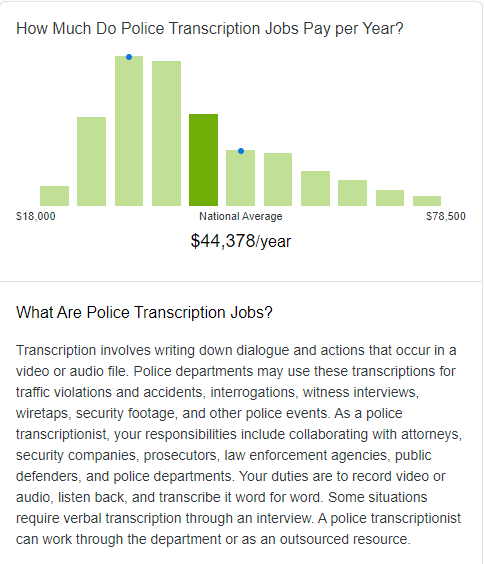
According to Ziprecruiter, the average pay for Police Transcription is $44,378/year.
Of course, if you work for a transcription company like Nettranscripts, SpeakWrite, Athreon, or Cambridge, your pay will be lower than if you work for a law enforcement agency directly or get your own clients.
A good way to get better-paying jobs faster is by taking a specialized course like Legal Transcription: Theory & Practice™ by Janet Shaughnessy
How to get police and law enforcement transcriptions jobs
You can find police transcription jobs advertised on indeed.com and other employment sites.
Visit indeed.com and do a search for law enforcement transcription jobs and police transcription jobs and you’ll typically see several law enforcement jobs advertised. Below are some companies providing law enforcement transcription and recruiting law enforcement transcriptionists:
- Nettranscripts.com says that they are serving hundreds of law enforcement agencies across the country. They often advertise jobs for law enforcement transcriptionists at indeed.com. Check their employment page at https://www.nettranscripts.com/careers.htm.
I posted an article about Net Transcripts and their qualification requirements. It will give you a good idea of what it takes to get law enforcement transcription work through a transcription company. - Speakwrite.com also provides law enforcement transcription.
- Athreon.com/law-enforcement-transcription-services.php
- Cambridge Transcriptions. See more information about Cambridge at https://generaltranscriptionworkfromhome.com/blog/work-from-home-legal-transcription-jobs-with-cambridge-transcriptions/
I hope that this article gave you some information on what it takes to become a law enforcement transcriptionist and what the work entails.
Janet Shaughnessy's legal transcription course
includes a full chapter about law enforcement transcription.
Get more information about her legal transcription course at https://generaltranscriptionworkfromhome.com/blog/legal.
Not sure if legal transcription is right for you?
Find out what’s involved in getting started as a legal transcriptionist working from home. Get answers to frequently asked questions about becoming a legal transcriptionist. Explore a career in legal transcription with Jane'ts free legal transcription mini-course.
Ready to get started in legal transcription?
Legal Transcription: Theory & Practice™ by Janet Shaughnessy
Is the legal transcription course I highly recommend.
Get Janet's detailed, multi-media legal transcription course now.
Disclaimer: I only recommend products I believe in. If you purchase a product through a referral link, I will get a commission. It won’t cost you a dime extra, and it helps me to keep providing you with quality information.
